Tuesday, 2 August 2016

IT'S HER BIRTHDAY!


Happy Birthday beautiful girl!

  I can almost put myself back into the photograph, standing at the door watching you write in your journal, taken, what, over twenty five years ago!   

Have a wonderful day!

Monday, 1 August 2016

IT'S TIME...


...to paint the fence.


Not really sure if the hand on the hip really improves the image that much!


Sunday, 24 July 2016

BAKING AND THINKING


Image result for apple and blueberries

Robyn and Con are coming for lunch.  David's making the mains and I'm making one of David Herbert's Weekend Australian recipes:  Apple, Blueberry and Almond Cake.  It's in the oven now and David said, when he came back from his walk with Molly, that the kitchen smells like Christmas.  Here's the recipe:

APPLE, BLUEBERRY AND ALMOND CAKE

125g butter, softened
125g caster sugar
1 tsp vanilla extract
2 eggs, beaten
100g self-raising flour
50ml milk
125g ground almonds
1 apple
100g blueberries

Topping
125g butter, melted
2 eggs
1 tsp cinnamon
50g flaked almonds

Preheat oven to 180 degrees C.  Grease and line base of a 20cm spring-form cake tin.  Beat butter, sugar and vanilla extract until fluffy then gradually beat in eggs, one at a time.  Add a little sifted flour if mixture looks as if it might separate.  Lightly fold in remaining flour, milk and half the almonds until combined.  Spread into base of cake tin,  Sprinkle with remaining ground almonds and then top with apple and blueberries.  To make topping, put melted butter in a bowl and whisk in eggs, sugar and cinnamon.  Pour over cake.  Sprinkle with flaked almonds.  Bake for about 60 minutes; when ready, it should be firm to the touch and a skewer inserted in the centre should come out clean.  Cool completely in the tin before turning out.  Dust with a little icing sugar to serve if desired.

And...something to think about...

Writing about the Prodigal Son, Baxter Kruger says in his little book, Parable of the Dancing God, 

"The third parable of Jesus in Luke 15 is without question among his most famous.  It is also his most loved.  It is about a father and his two sons.  And this fact alone endears the parable to us.  It is most often called 'the parable of the prodigal son', or 'the parable of missing the whole point'.  But this story is not really about either the prodigal son or the blind son.  It is about the father.  He is the central figure.  And Jesus is using this father and his relationship with his two sons to reveal to us the shocking truth about God.

This story is about who God is and what God is actually like.  It is about the way God thinks, how He thinks.  It is about the way God acts towards us.  It is about the Father's heart and joy.  It is a story of a God we can believe in..."

Image result for the prodigal son

Saturday, 23 July 2016

IT'S THE WEEKEND!


...and I hope you are relaxing too!  Took this photograph a couple of years ago.

Thursday, 14 July 2016

HUGO THE DOG


This is Hugo!  And he belongs to Sarah who lives in Tasmania and I think that Sarah loves him very much.  Liliane!  I think you need to look for a dog like Hugo to add to your collection!


FINALLY...THE TRUTH


Beuchner discussing King Lear...

...Insofar as the truth is tragic, he told a tragedy of men and women suffering more than even their own folly and wickedness seem to merit.  Insofar as the truth is comic, both in the sense of a kind of terrible funniness and of a happy end to all that is terrible, he told a comedy of madmen and fools.  Insofar as the truth transcends all such distinctions and points beyond itself, he told a kind of fairy tale where everybody is disguised as something he or she is not and only at the end are all disguises stripped away so that finally all are revealed for what they truly are, and like the beast in "Beauty and the Beast," the old king, with Cordelia in her beauty dead in his arms, is finally turned into a human being...

Did you notice the three "insofars" in the passage above?  Read the passage again and understand more deeply what Buechner is saying here.

Here is the preceding paragraph...

What (Shakespeare) ought to have said in his play was one or the other of these - despair or hope - but instead what he said was both of them and thus something in a way more than, and different from, either.  What he said was what in the deepest sense he truly felt.  He looked into the dark heart of things, which is to say into his own heart and into our hearts too, and told as close to the whole truth as he was able.  


Exerpts from
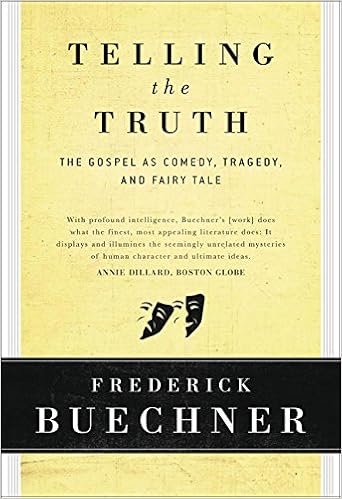
Telling the Truth (The Gospel as Tragedy, Comedy and Fairy Tale) Frederick Beuchner

Monday, 11 July 2016

TELLING THE TRUTH...


Reading this wonderful book again where the writer uses the play King Lear to discuss the Gospel in a creative way...

"...The crazy Zen monk holds a stick in his hand and says, "What have I got in my hand?" and the eager searcher after truth but only after a particular truth says, "It is a stick."  Then the monk hits the man over the head with the stick as he richly deserves and says, "No, that's what it is," or doesn't even bother to say it.  Pilate asks Jesus what is truth - is it what Plato said, or Maimonides, or Aquinas, or Tillich...and what Jesus hits Pilate over the head with is Pilate himself.  Jesus just stands there in silence in a way that throws Pilate back on his own silence, the truth of himself."