Why are some relationships marriage, and other relationships not? this is a vital question to consider. If our view of marriage does not offer a meaningful, non-arbitrary distinction between marital and non-marital relationships, and if that distinction does not justify central marriage norms such as fidelity and permanence, then our view of marriage more than likely gets marriage wrong. By this metric, the conjugal view of marriage makes the most sense.
In the conjugal view, marriage involves two partners sharing a domestic life that is directed towards and naturally unfolds into procreation and child raising. That is, partners in a marriage unite - or coordinate - towards procreation. In this view, marriage is different from all other relationships because its unifying good is procreation. No other relationship, be it roommates, siblings, best friends or boyfriend/girlfriend, share that unifying good. Further, this distinction justifies the public norms of sexual activity, permanence and fidelity.
On the other hand, in the revisionist view, marriage is thought to reflect a deep emotional connection between partners. Instead of procreation, the unifying good of marriage is mutual personal fulfillment. However, many non-marital relationships (such as chess partners, dating relationships, or best friends) can also share a deep emotional connection, coordinate towards mutual fulfillment. Further, when marriage is viewed in this light, there is no particular reason marriage ought to be sexual, and no particular reason why permanence and fidelity ought to be public expectations rather than matters of personal preference. So we have no meaningful distinction that justifies important marriage norms...
Extract from www.discussingmarriage.com
Showing posts with label thinking. Show all posts
Showing posts with label thinking. Show all posts
Monday, 28 August 2017

Saturday, 26 August 2017
TWO DIFFERENT VIEWS OF MARRIAGE
Most of the debate around marriage occurs because there are two competing understandings of marriage fighting for dominance in our society: the conjugal view and the revisionist view. These two views of marriage have dramatically different implications for what marriage policy should look like. Whichever view of marriage informs state policy can have a dramatic impact on the legal and social norms surrounding families and children
Two Different Views of Marriage
The conjugal view holds that marriage is a union between a man and a woman who share a domestic life oriented towards child-bearing and child-rearing. In other words, procreation (creating new human life) is the unifying good of a marriage relationship. A 'unifying good' is that activity that most completely unites the partners in the relationship - the purpose towards which they coordinate their joint activities. Personal satisfaction and emotional companionship are important parts of marriage, but not its defining features.
By contrast, in the revisionist view, the defining feature of marriage is an emotional and sexual companionship between partners. From this perspective, marriage is all about romance, love and mutual affection. Only the partners can say what ought to be the case about their marriage, since their personal fulfillment is the primary purpose of the relationship - the good towards which they coordinate their activities. Procreation is a secondary consideration (at best) in this view of marriage - something that partners can do together if they wish, just as any other activity.
If one holds the revisionist view of marriage, it makes no sense to exclude same-sex couples, That's why so many people support same-sex marriage today - it is because they accept (we think uncritically) the revisionist premise that marriage is all about mutual adult fulfillment. In contrast, if one holds the conjugal view of marriage, there are legitimate fears that formalising same-sex marriage will undermine some of marriage's central stabilising norms (permanence, fidelity etc.
excerpt from www.discussingmarriage.org
Two Different Views of Marriage
The conjugal view holds that marriage is a union between a man and a woman who share a domestic life oriented towards child-bearing and child-rearing. In other words, procreation (creating new human life) is the unifying good of a marriage relationship. A 'unifying good' is that activity that most completely unites the partners in the relationship - the purpose towards which they coordinate their joint activities. Personal satisfaction and emotional companionship are important parts of marriage, but not its defining features.
By contrast, in the revisionist view, the defining feature of marriage is an emotional and sexual companionship between partners. From this perspective, marriage is all about romance, love and mutual affection. Only the partners can say what ought to be the case about their marriage, since their personal fulfillment is the primary purpose of the relationship - the good towards which they coordinate their activities. Procreation is a secondary consideration (at best) in this view of marriage - something that partners can do together if they wish, just as any other activity.
If one holds the revisionist view of marriage, it makes no sense to exclude same-sex couples, That's why so many people support same-sex marriage today - it is because they accept (we think uncritically) the revisionist premise that marriage is all about mutual adult fulfillment. In contrast, if one holds the conjugal view of marriage, there are legitimate fears that formalising same-sex marriage will undermine some of marriage's central stabilising norms (permanence, fidelity etc.
excerpt from www.discussingmarriage.org
Monday, 12 December 2016
SONG FOR MONDAY


Christmas is coming! Beds all made for family coming from Geneva, hearts scattered around the place and the tree's up.
The desk painted up beautifully Emma.
Saturday, 19 November 2016

Monday, 7 November 2016
A FUNDAMENTAL CHANGE HAS OCCURRED

...When people enter a witness protection program, they are given a new identity. Their old name, accounts, places, daily routines, and even relationships have to be put in the past. They become someone new.
When we are born in Christ, we become someone new too. We may look the same as we did before, but a fundamental change has occurred. The Christian life is an exchanged life. Jesus took our identity to the cross and then filled us with His identity. Instead of living our own self-oriented lives, He lives His life through us. He took all that we have upon Himself and gave us in exchange all that He has - His name, His authority, His inheritance, and more. As Paul said, we no longer live; He lives in us.
That means we don't have to depend on our own wisdom, love, faith, or any other quality. We don't even pray in our own name anymore. We use His. His presence within us provides all we need. We can claim His faith, His ideas, and His solutions for everything we need. We can have His humility, patience, boldness, compassion, and any other of His attributes we need. Instead of focusing on the how, we focus on the who and let Him be Himself within us. Over time, we begin to love or forgive or have bold faith not because we should but because that's who we are. The life of God within us will be expressed if we will let Him express Himself...
Excerpt from Experiencing God's Presence Devotional (Chris Tiegreen) and here in South East Queensland the Jacarandas are all in flower.
Sunday, 6 November 2016

Saturday, 29 October 2016
WEDNESDAY QUILTING

We have been meeting at Kerrie's for over fifteen years. Here's what Leona's working on...and this,

and these...

Val...


This is going to be super gorgeous. These 'strips' with all her 'blue' work will make up a super, duper quilt.
and Kerrie J....


English paper pieceing in Civil War materials...
Dear Robyn continues working on her latest Crazy....

Kerrie K on her applique
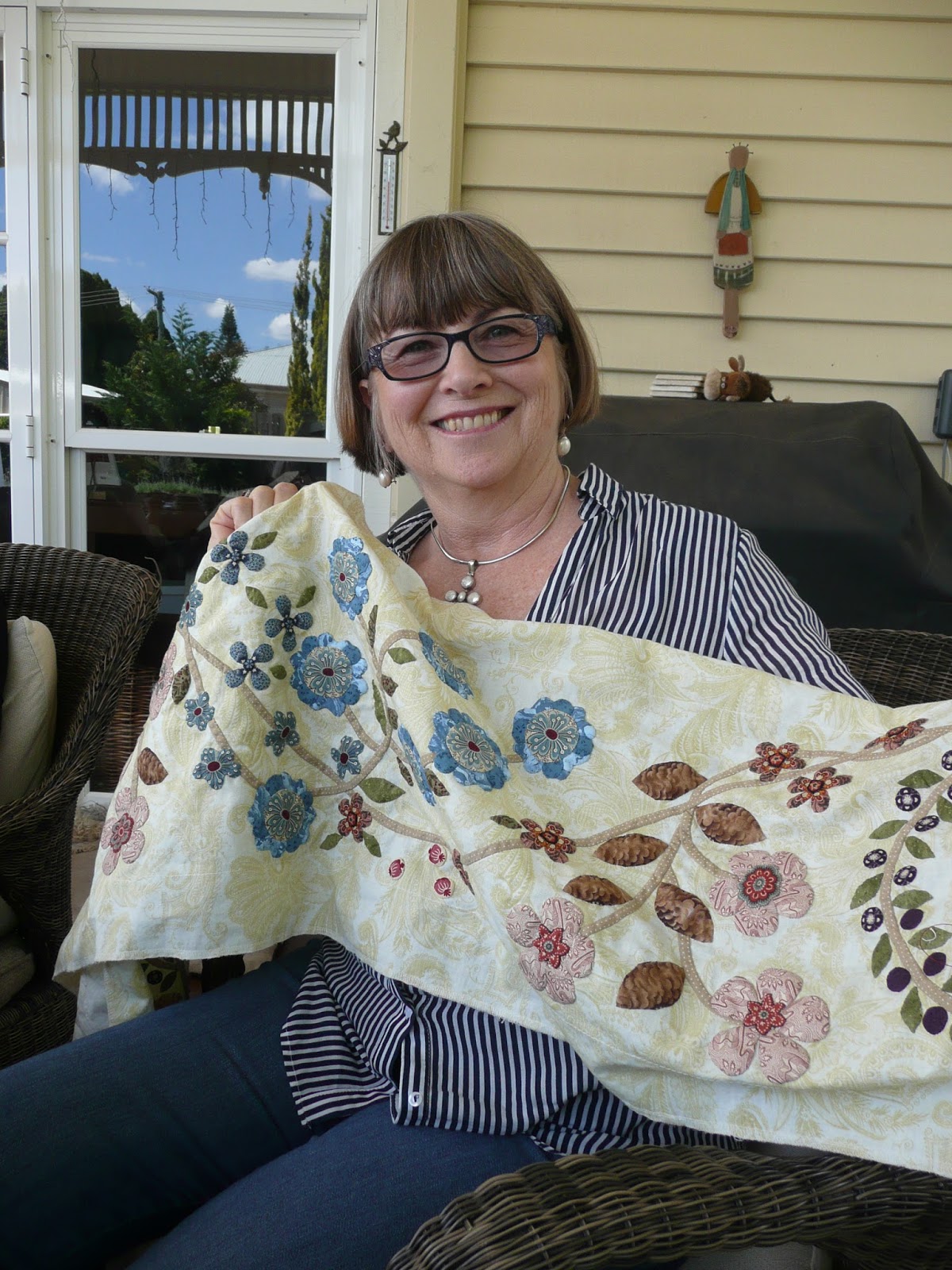

and...dear Lynne is making this for her new sewing room...

And let's not forget moi...

Nearly finished off an old project from long, long ago. A wee angel in need of some eyes!
Sunday, 23 October 2016
SUNDAY SEWING AND...

...thinking about this quote from Brennan Manning's book ABBA'S CHILD.
"...And there have been times...
when the felt presence of God was more real to me
than the chair I am sitting on;
when the Word ricocheted like broken-backed
lightning in every corner of my soul;
when a storm of desire carried me to places I had
never visited.
And there have been other times...
when I identified with the words of Mae West: "I
used to be Snow White - but I drifted";
when the Word was as stale as old ice cream and
as bland as tame sausage;
when the fire in my belly flickered and died;
when I mistook dried-up enthusiasm for gray-haired
wisdom;
when I dismissed youthful idealism as mere
naivete;
when I preferred cheap slivers of glass to the pearl
of great price.
If you relate to any of these experiences, you might want to browse through this book and pause to reclaim your core identity as Abba's Child."

Thursday, 20 October 2016
THE COURAGE TO RISK

...The constant challenge in this life we call Christian is the translation of what we believe into our day-to-day lifestyle. Risky business!
This doesn't, of course mean conforming to some prescribed pattern of enthusiastic affection... Rather, it is a thing of complete spontaneity, unprogrammed and unpredictable. It is more likely to make us feel foolish (if we are the least bit self-conscious) than to make us feel that at last we have arrived at Christian maturity. In order to do more than adopt a passing fad, we never forget that the spontaneous affection erupting within us is the love of God poured into our hearts by the Holy Spirit.
The courage to risk approaching an enemy to seek reconciliation belongs in the same category. It will expose us to very probable rejection, ridicule and failure...In season and out of season, in success and failure, in grace and disgrace, the courage to risk everything on the signature of Jesus is the mark of authentic discipleship...
Excerpt from Signature of Jesus (Brennan Manning)
David took this photograph last year - somewhere in Scotland.
Thursday, 13 October 2016
NEVERTHELESS
nevertheless
adverb
in spite of that; notwithstanding; all the same

Last blog on Paul Kalanithi's book WHEN BREATH BECOMES AIR. Here he discusses his thoughts on belief in God and Christianity.
"The favorite quote of many an atheist, from the Nobel Prize-winning French biologist Jacques Monod...
'The ancient covenant is in pieces; man at last knows that he is alone in the unfeeling immensity of the universe, out of which he emerged only by chance.'
Yet I returned to the central values of Christianity - sacrifice, redemption, forgiveness - because I found them so compelling. There is a tension in the Bible between justice and mercy, between the Old Testament and the New Testament. And the New Testament says you can never be good enough: goodness is the thing, and you can never live up to it. The main message of Jesus, I believed, is that mercy trumps justice every time.
Not only that, but maybe the basic message of original sin isn't "Feel guilty all the time." Maybe it is more along these lines: "We all have a notion of what it means to be good, and we can't live up to it all the time." Maybe that's what the message of the New Testament is, after all. Even if you have a notion as well defined as Leviticus, you can't live that way. It's not just impossible, it's insane."
And that is the message of the Bible. Paul in Romans 7 describes this conundrum beautifully, "I do not understand what I do. For what I want to do I do not do, but what I hate I do." And the Good News is that NEVERTHLESS, God loves us. And that 'love' is a 'love' beyond all definitions.
The beautiful quilt? Another one of Robyn's - for her grand-daughter.
Saturday, 8 October 2016
MAKING SENSE OF HIS OWN EXISTENCE

David picked this book up from the Library for me yesterday. I read a review on the book some time ago, took myself off to the Library and ordered it in. There were twelve people ahead of me waiting to borrow it. Yesterday an email arrived in my inbox and David went and collected it for me. I finished reading it last night before I went to sleep.
From the flyleaf:
"Paul Kalanithi was a neurosurgeon and writer. He held degrees in English Literature, human biology, and history and philosophy of science and medicine from Stanford and Cambridge universities before graduating from Yale School of Medicine. He also received the American Academy of Neurological Surgery's highest award for research."
At the age of thirty-six, on the verge of completing a decade's training as a neurosurgeon, he was diagnosed with inoperable lung cancer.
This book was written during his illness, before and after his daughter was born. Here's a 'taste'.
"...I had learned something, something not found in Hippocrates, Maimonides, or Osler: the physician's duty is not to stave off death or return patients to their old lives, but to take into our arms a patient and family whose lives have disintegrated and work until they can stand back up and face, and make sense of, their own existence."
And for his daughter to whom the book is dedicated:
"...When you come to one of the many moments in life where you must give an account of yourself, provide a ledger of what you have been, and done, and meant to the world, do not, I pray, discount that you filled a dying man's days with a sated joy, a joy unknown to me in all my prior years, a joy that does not hunger for more and more, but rests, satsified. In this time, right now, that is an enormous thing..."

Monday, 3 October 2016
ANOTHER GREAT BOOK

Greer sent this book to David for his birthday and I've just finished reading it.
The Guardian review here emphasizes the theme of, "...what happens when real life is exploited in fiction..." For me though the major theme of the book is how the children are affected from the breakdown of their parents' marriages.
Anyone reading this book while considering having an affair or leaving their partner would, I think, think twice.
Saturday, 1 October 2016
A NEW IDEA OF GREATNESS

While the leg heals, I have lots of time for reading. Here's an excerpt from this book:
"...The second major feature of Jesus' life; Jesus lived for others. He was not simply called but actually was the friend of publicans and sinners. He befriended the rabble, the riffraff of his own culture. One of the mysteries of the gospel tradition is this strange attraction of Jesus to the unattractive, his strange desire for the undesirable, his strange love for the unlovely. The key to this mystery is, of course, the Father. Jesus does what he sees the Father doing, he loves those whom the Father loves.
The gentleness of Jesus with sinners flowed from his ability to read their hearts and to detect the sincerity and goodness there. Behind men's grumpiest poses and most puzzling defense mechanisms, behind the arrogance and airs, behind their sneers and curses, Jesus saw little children who hadn't been loved enough and who had ceased growing because someone had ceased believing in them. Perhaps it was his extraordinary sensitivity and compassion that caused Jesus (and later the apostles) to speak of the faithful as "children", no matter how tall, rich, clever and successful they might be.
When Jesus tied a towel around his waist, poured water into a copper basin, and washed the feet of the apostles (the dress and duty of a slave), the Maundy Thursday revolution began, and a new idea of greatness in the kingdom of God emerged..."
Saturday, 24 September 2016
HIS FIRST WORD TO US

"...Yet he (a man Jesus met - Matthew 5) was called, as we are called, to listen attentively to God's first word to us. This word is the gift of ourselves to ourselves - our existence, our nature, our personal history, our uniqueness, our identity. All that we have and are is one of the unique and never-to-be-repeated ways God has chosen to express himself in space and time."
Excerpt from Manning's book above (Italics mine)
Monday, 12 September 2016

Wednesday, 31 August 2016
THE FISH IN SCOTLAND DISCOVERED SOMETHING NEW

In the midst of the varied discussions on the proposed changes to marriage laws Rabbi Sacks in November last year, delivered this keynote presentation in front of an audience of faith leaders and scholars from across religions and 23 countries around the world.
"I want this morning to begin our conversation by one way of telling the story of the most beautiful idea in the history of civilization: the idea of the love that brings new life into the world. There are of course many ways of telling the story, and this is just one. But to me it is a story of seven key moments, each of them surprising and unexpected.
The first, according to a report in the press on 20th October of this year, took place in a lake in Scotland 385 million years ago. It was then, according to this new discovery..."
You can find a transcript of his presentation here.
Sunday, 24 July 2016
BAKING AND THINKING

Robyn and Con are coming for lunch. David's making the mains and I'm making one of David Herbert's Weekend Australian recipes: Apple, Blueberry and Almond Cake. It's in the oven now and David said, when he came back from his walk with Molly, that the kitchen smells like Christmas. Here's the recipe:
APPLE, BLUEBERRY AND ALMOND CAKE
125g butter, softened
125g caster sugar
1 tsp vanilla extract
2 eggs, beaten
100g self-raising flour
50ml milk
125g ground almonds
1 apple
100g blueberries
Topping
125g butter, melted
2 eggs
1 tsp cinnamon
50g flaked almonds
Preheat oven to 180 degrees C. Grease and line base of a 20cm spring-form cake tin. Beat butter, sugar and vanilla extract until fluffy then gradually beat in eggs, one at a time. Add a little sifted flour if mixture looks as if it might separate. Lightly fold in remaining flour, milk and half the almonds until combined. Spread into base of cake tin, Sprinkle with remaining ground almonds and then top with apple and blueberries. To make topping, put melted butter in a bowl and whisk in eggs, sugar and cinnamon. Pour over cake. Sprinkle with flaked almonds. Bake for about 60 minutes; when ready, it should be firm to the touch and a skewer inserted in the centre should come out clean. Cool completely in the tin before turning out. Dust with a little icing sugar to serve if desired.
And...something to think about...
Writing about the Prodigal Son, Baxter Kruger says in his little book, Parable of the Dancing God,
"The third parable of Jesus in Luke 15 is without question among his most famous. It is also his most loved. It is about a father and his two sons. And this fact alone endears the parable to us. It is most often called 'the parable of the prodigal son', or 'the parable of missing the whole point'. But this story is not really about either the prodigal son or the blind son. It is about the father. He is the central figure. And Jesus is using this father and his relationship with his two sons to reveal to us the shocking truth about God.
This story is about who God is and what God is actually like. It is about the way God thinks, how He thinks. It is about the way God acts towards us. It is about the Father's heart and joy. It is a story of a God we can believe in..."
Thursday, 14 July 2016
FINALLY...THE TRUTH

Beuchner discussing King Lear...
...Insofar as the truth is tragic, he told a tragedy of men and women suffering more than even their own folly and wickedness seem to merit. Insofar as the truth is comic, both in the sense of a kind of terrible funniness and of a happy end to all that is terrible, he told a comedy of madmen and fools. Insofar as the truth transcends all such distinctions and points beyond itself, he told a kind of fairy tale where everybody is disguised as something he or she is not and only at the end are all disguises stripped away so that finally all are revealed for what they truly are, and like the beast in "Beauty and the Beast," the old king, with Cordelia in her beauty dead in his arms, is finally turned into a human being...
Did you notice the three "insofars" in the passage above? Read the passage again and understand more deeply what Buechner is saying here.
Here is the preceding paragraph...
What (Shakespeare) ought to have said in his play was one or the other of these - despair or hope - but instead what he said was both of them and thus something in a way more than, and different from, either. What he said was what in the deepest sense he truly felt. He looked into the dark heart of things, which is to say into his own heart and into our hearts too, and told as close to the whole truth as he was able.
Exerpts from
Telling the Truth (The Gospel as Tragedy, Comedy and Fairy Tale) Frederick Beuchner
Monday, 11 July 2016
TELLING THE TRUTH...
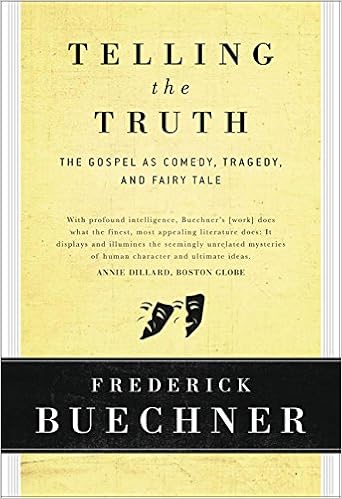
Reading this wonderful book again where the writer uses the play King Lear to discuss the Gospel in a creative way...
"...The crazy Zen monk holds a stick in his hand and says, "What have I got in my hand?" and the eager searcher after truth but only after a particular truth says, "It is a stick." Then the monk hits the man over the head with the stick as he richly deserves and says, "No, that's what it is," or doesn't even bother to say it. Pilate asks Jesus what is truth - is it what Plato said, or Maimonides, or Aquinas, or Tillich...and what Jesus hits Pilate over the head with is Pilate himself. Jesus just stands there in silence in a way that throws Pilate back on his own silence, the truth of himself."
Subscribe to:
Posts (Atom)